
Trinity of identity-session-behavior
Connects who used AI, which session carried the action, and what behavior occurred.
Gensight
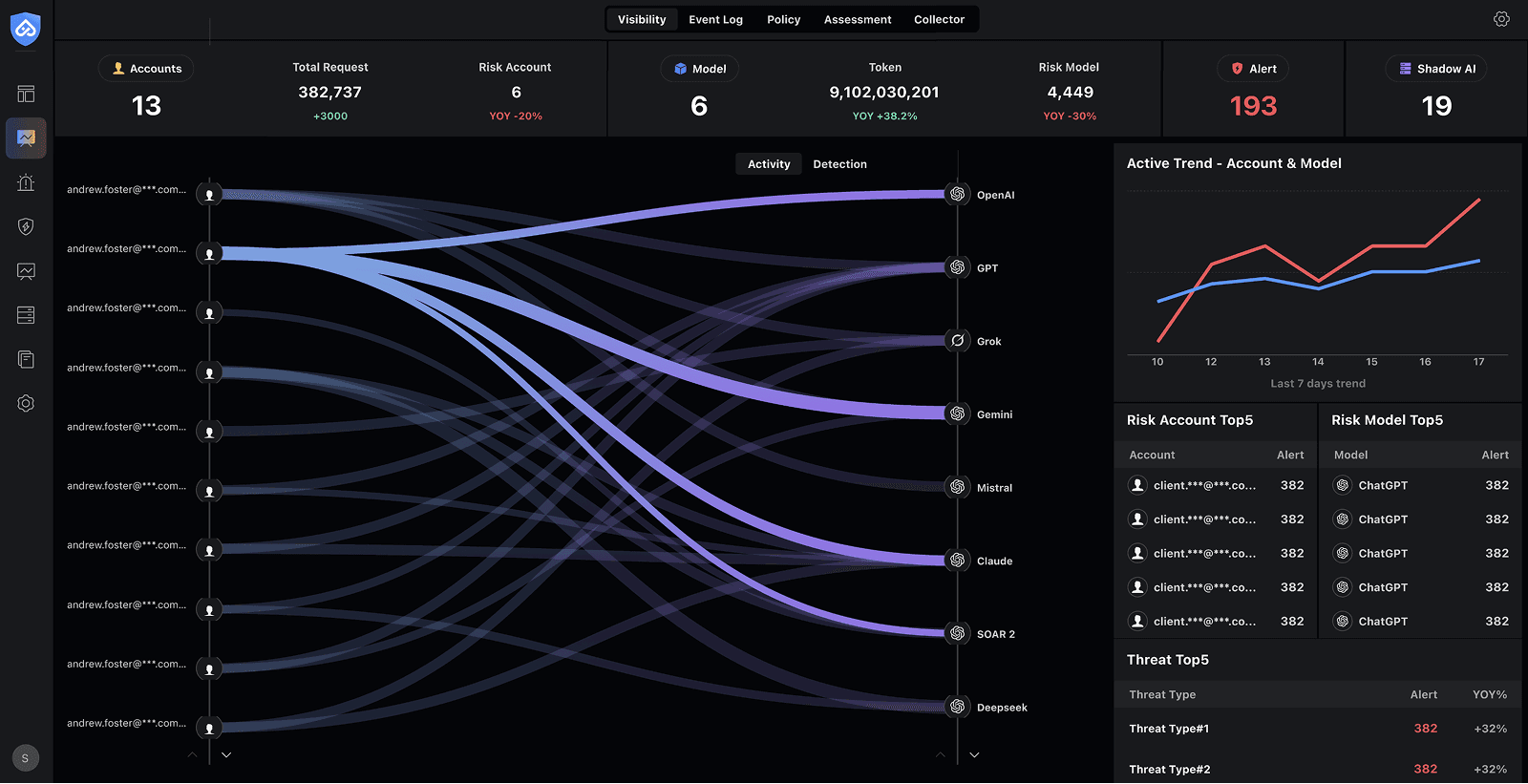
Gensight safeguards AI applications, agents, and data flow through unified visibility, threat detection, and proactive assessment.
The Figma source lists six Gensight feature paths: identity-session-behavior correlation, semantic analysis, encrypted reconstruction, end-to-network governance, localized protection, and AI-agent-era native defense.
Connects who used AI, which session carried the action, and what behavior occurred.
Inspects ambiguous prompts, metaphorical expressions, and progressive attack intent beyond regular-expression or keyword matching.
Rebuilds prompt content, model reasoning parameters, and multi-round conversation context for accountable AI operations.
Treats AI communication as a controllable runtime path rather than a hidden side channel.
Supports localized AI defense expectations without publishing deployment-speed proof before approval.
AI activity visibility
Source proof is held until approval.
Scenario coverage
Source proof is held until approval.
Risk evidence
Source proof is held until approval.
Response latency
Source proof is held until approval.
Gensight continuously safeguards the security of AI applications, AI agents, and data flow through unified visibility, threat detection, and proactive security assessment capabilities.
Gensight collects AI behavior through endpoint bypass monitoring, proxy control, and asynchronous integration, while withholding the source file's numerical visibility and launch-speed claims.
Endpoint bypass monitoring model
Observes AI usage at the endpoint layer for environments where direct application integration is constrained.
Proxy control model
Places AI communication under an enforceable path for policy review and runtime response.
Asynchronous integration model
Connects public LLM access, API calls, and enterprise-built AI services into the same audit surface.
Deep semantic reconstruction
Breaks investigation dependence on surface metadata by reconstructing prompt content and conversation context.
Source copy describes an asset inventory and behavior audit system for opaque AI paths and ambiguous responsibility boundaries.
AI asset inventory
Maintains a register of AI applications, access points, users, sessions, and data-flow paths.
Behavior audit trail
Links usage records to identities and sessions so review teams can reconstruct operational responsibility.
Gensight dynamically identifies legal and security risk during AI interactions, connecting activity visibility with policy review.
Interaction-time monitoring
Evaluates AI requests, responses, and context while activity is still operationally relevant.
Policy review workflow
Routes flagged AI behavior into compliance, security, and investigation workflows.
The source frames Gensight as an enforcement layer on the AI communication path, creating a closed loop from observation to governance.
Communication-path enforcement
Applies runtime policy attention to AI traffic instead of leaving AI usage as unmanaged side activity.
Closed-loop governance
Connects detection, review, response, and evidence capture into one operational loop.

AI governance for industrial operations where model use intersects with safety, data, and control boundaries.

Visibility and response patterns for AI activity in regulated aviation workflows.

Scenario framing for distributed logistics, route, and operational AI usage.
Gensight
Gensight safeguards AI applications, agents, and data flow through unified visibility, threat detection, and proactive assessment.